Asthma
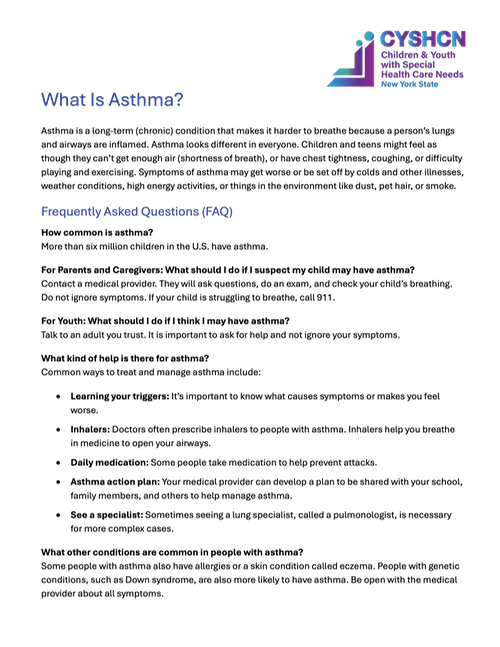
Asthma is a long-term (chronic) condition that makes it harder to breathe because a person's lungs and airways are inflamed. Asthma looks different in everyone. Children and teens might feel as though they can't get enough air (shortness of breath), or have chest tightness, coughing, or difficulty playing and exercising. Symptoms of asthma may get worse or be set off by colds and other illnesses, weather conditions, high energy activities, or things in the environment like dust, pet hair, or smoke.
Frequently Asked Questions (FAQ)
How common is asthma?
More than six million children in the U.S. have asthma.
For Parents and Caregivers: What should I do if I suspect my child may have asthma?
Contact a medical provider. They will ask questions, do an exam, and check your child's breathing. Do not ignore symptoms. If your child is struggling to breathe, call 911.
For Youth: What should I do if I think I may have asthma?
Talk to an adult you trust. It is important to ask for help and not ignore your symptoms.
What kind of help is there for asthma?
Common ways to treat and manage asthma include:
- Learning your triggers: It's important to know what causes symptoms or makes you feel worse.
- Inhalers: Doctors often prescribe inhalers to people with asthma. Inhalers help you breathe in medicine to open your airways.
- Daily medication: Some people take medication to help prevent attacks.
- Asthma action plan: Your medical provider can develop a plan to be shared with your school, family members, and others to help manage asthma.
- See a specialist: Sometimes seeing a lung specialist, called a pulmonologist, is necessary for more complex cases.
What other conditions are common in people with asthma?
Some people with asthma also have allergies or a skin condition called eczema. People with genetic conditions, such as Down syndrome, are also more likely to have asthma. Be open with the medical provider about all symptoms.
Talking with a Medical Provider
When talking with medical providers or specialists, you might want to:
- Bring notes! Keep track of your concerns or issues that others have pointed out.
- Ask questions like:
- "How can I find out what triggers asthma and prevent symptoms?"
- "Can you show us how to use the inhaler?"
- "Is daily medication needed or just when symptoms happen?"
What You Can Do at Home
Whenever someone is having trouble breathing, seek medical care immediately! In between appointments, you can:
- Review your asthma action plan: Know what to do during an attack.
- Track symptoms: Keeping track of symptoms can help you notice patterns and avoid triggers.
- Be active: With the right treatment, children can play sports, go to recess, and be as active as they want to be.
- Practice staying calm: Relaxation can help during an asthma attack. It is important that adults remember this too, since children pick up on the energy of others.
- Have fun: Joy can help lower stress. Keep doing favorite activities, just modify if needed.
Go Deeper
Find Resources
Search New York State
Families, caregivers, youth, and community partners in New York State can use this searchable resource guide to find information, services, and support. ACT for Youth.
AAP Resources
Start here to find more information on asthma action plans, use the AAP asthma tracker, and learn more about common triggers. American Academy of Pediatricians (AAP).
Asthma Treatments
Medications for Children
Each child's asthma symptoms are different, and symptoms can change over time. Learn more about types of medicine and devices here. AAP.
Biologics
Many people are able to control asthma by identifying and avoiding triggers, taking a daily medication, and using a quick-relief inhaler when symptoms develop. For people with more severe asthma, biologics — medications that target a specific antibody, molecule, or cell involved in asthma — may be an option. American Academy of Allergy, Asthma & Immunology (AAAAI).
Asthma in Adolescence
Asthma and Adolescents
Managing asthma in adolescents may be challenging due to hormonal changes, increased physical activity, and shifting social dynamics. AAAAI.
For Teens
Written for teens, this article describes what asthma is and answers questions teens may have about asthma. Nemours.
About This Series
This series of handouts and web pages on health conditions was written by clinicians in Weill Cornell Medicine's Pediatric Mental Health Integration Program, partners in the ACT for Youth CYSHCN Program Center of Excellence at Cornell University.