Mental Health Conditions
Too many children and young people today are experiencing serious mental health challenges — but help is available. On this page for families and caregivers, we connect you to:
- Useful national websites
- New York State resources and services for families
- Sites for understanding specific conditions: bipolar disorder, borderline personality disorder, eating disorders, obsessive-compulsive disorder, non-suicidal self-injury, psychosis, and schizophrenia
Visit our pages on attention-deficit/hyperactivity disorder, anxiety, behavioral/conduct problems, depression, and substance use disorder.
- Need help now? Call 988 to be connected to crisis services, or see the other mental health help lines listed in the sidebar.
Useful National Websites
National Alliance on Mental Illness (NAMI)
NAMI is an alliance of more than 650 local partners who work in your community to raise awareness and provide support and education.
Child Mind Institute
The Child Mind Institute is a global nonprofit working to transform children's mental health. Browse their site for parent guides, articles, videos, the Thriving Kids Podcast, and more.
Healthy Children: Mental Health Conditions
The American Academy of Pediatricians (AAP) offers an extensive website for parents with useful articles and information on a wide range of health conditions. Here, learn more about mental health conditions that can affect children and teens. AAP.
Resources for New York State Families
Search NYS
Families, caregivers, youth, and community partners in New York State can use this searchable resource guide to find information, services, and support. ACT for Youth.
Family Resource Toolkit
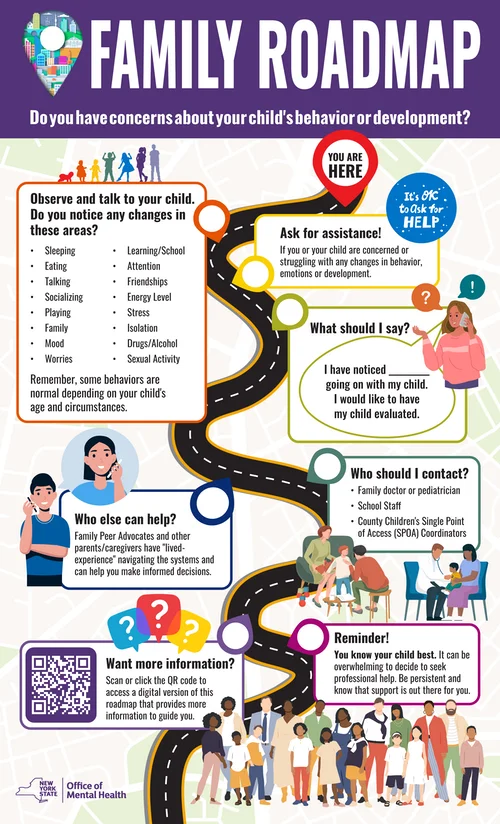
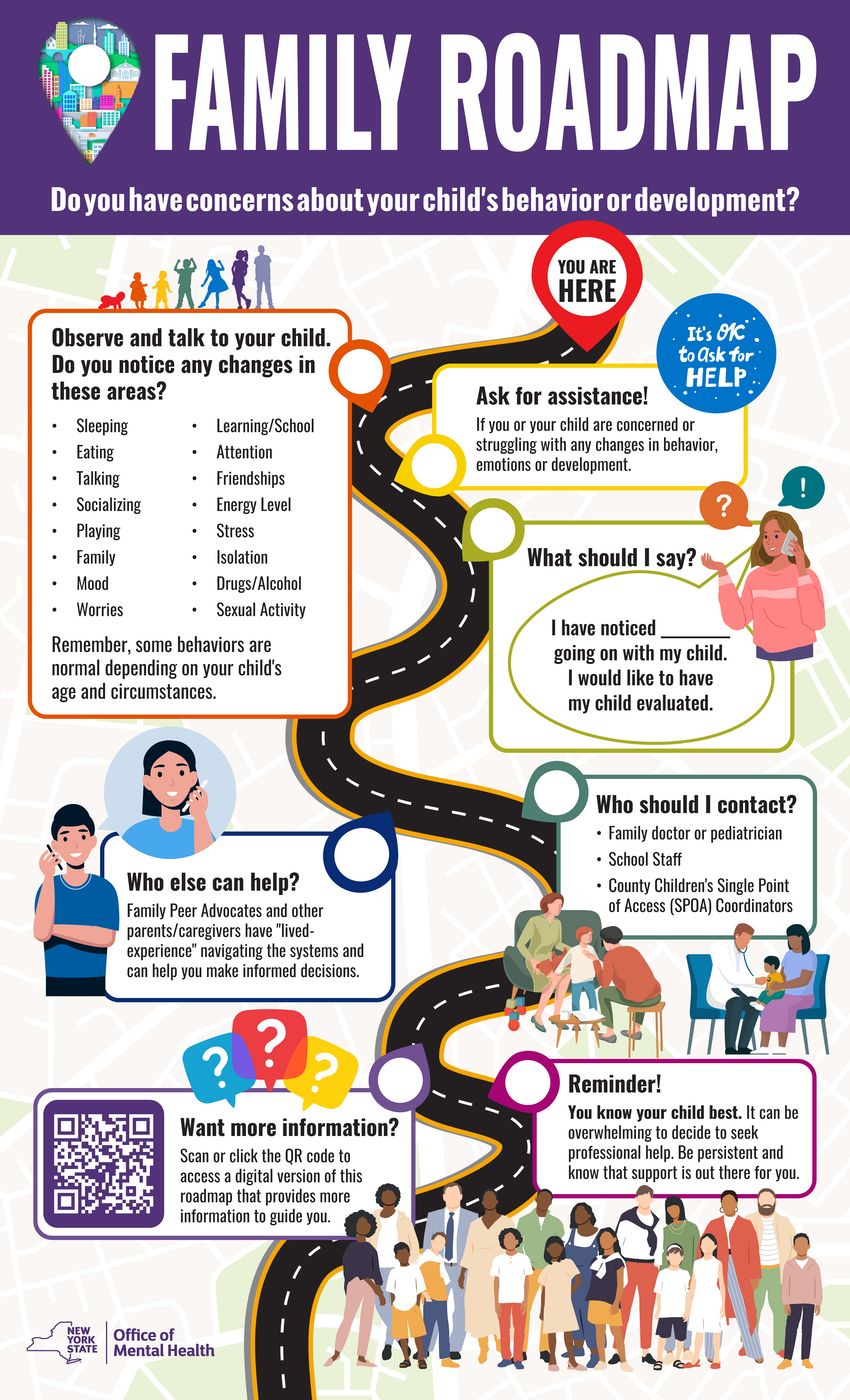
To show parents and caregivers how to take the first steps toward getting support, the Family Resource Toolkit includes a poster, brochure (print and digital versions), and business card. View the brochure for links to additional resources. Available in multiple languages. NYS Office of Mental Health and NYS Systems of Care.
Single Point of Access
The Single Point of Access (SPOA) program helps providers connect people with serious mental illness to mental health services that can accommodate them. Through these services, people with serious mental illness can connect to treatment, communicate with providers, and get help finding benefits. Each local government in New York State must designate a SPOA for children and families. NYC Health and NYS Conference of Local Mental Hygiene Directors.
New York State Office of Mental Health
Here, find 1) brief descriptions of services available in New York State, and 2) a collection of tip sheets and other resources developed to support mental health and wellness. NYS Office of Mental Health.
Resources for Youth, Parents, Caregivers, Friends, and Families
These resources and tools are designed by medical providers to help youth, families, caregivers, and friends understand and build positive mental health. Project TEACH.
Starting Points: Specific Mental Health Conditions
For each condition below, we link to a single trusted resource to get you started. Remember to visit Search NYS for additional resources.
Bipolar Disorder
Bipolar disorder is a mental health condition that causes cycles of extreme emotional changes. Read this guide to learn about symptoms, diagnosis, and treatment. Child Mind Institute.
Borderline Personality Disorder
People with borderline personality disorder (BPD) experience extreme emotions. Once a powerful emotion is triggered, it is very hard for them to calm down. People with BPD often have unstable relationships and engage in self-destructive behavior. BPD is now diagnosed and treated in teenagers. When young people get the right treatment early, they do better. Child Mind Institute.
Eating Disorders
This collection of resources on eating disorders provides an overview as well as specific information on anorexia, bulimia, binge eating, picky eating and ARFID, eating disorders in college, and treatment. Child-Mind Institute.
Obsessive-Compulsive Disorder (OCD)
OCD is a serious and often debilitating mental health disorder that affects people of all ages and walks of life, and occurs when a person gets caught in a cycle of obsessions and compulsions. This website provides resources for learning more about OCD in children and adolescents, and for getting help. It includes a section for children (including articles and videos). International OCD Foundation.
Non-Suicidal Self-Injury (NSSI)
Non-suicidal self-injury (NSSI) is the deliberate, self-inflicted destruction of body tissue resulting in immediate damage, without suicidal intent and for purposes not culturally sanctioned. This website provides a wealth of resources for parents, young people with a history of self-injury, and professionals who work with youth. Bronfenbrenner Center for Translational Research, Cornell University.
Psychosis and Schizophrenia
Psychosis is a mental state in which a person loses touch with reality, experiencing hallucinations or delusions. Schizophrenia, often diagnosed in the teen or young adult years, is a mental health condition that is characterized by episodes of psychosis. While psychosis can indicate schizophrenia, a young person may experience psychosis without having schizophrenia. Child Mind Institute offers a guide to schizophrenia and a collection of articles on both schizophrenia and psychosis. One article in particular, linked below, highlights early signs and prevention of psychosis. Child Mind Institute.